
Home / WHMIS Online / Course
WHMIS 2015 · GHS
WHMIS 2015 online course
Free and self-paced: work through 6 short lessons, then take the 15-question final test. Pass with 12 or more correct answers and you can order your WHMIS certificate for $20 — the certificate is optional.
Course developed by Geet Ramsamooj, B.Sc., M.Sc. (Safety), CRSP. Your progress is saved in this browser.
Course objectives
In this course you will learn:
- What WHMIS and the Globally Harmonized System (GHS) are, and how they work
- The responsibilities of the supplier, the employer and the worker
- The hazard classes of hazardous products, and their effects
- Appropriate emergency responses for a variety of hazardous products
- How to read and interpret standardized WHMIS labels, markings and other identification
- How to read and interpret the 16 sections of a Safety Data Sheet (SDS)
- How to improve safe working conditions and safe work practices
Work through the lessons in order: each one unlocks when you answer its review questions correctly. Use “Listen to this lesson” to have the lesson read aloud.
Lesson 1 of 6
What is WHMIS?
Complete the review questions in the previous lesson to unlock this lesson.
WHMIS — the Workplace Hazardous Materials Information System — is Canada’s nation-wide, legislated system for communicating information about the hazards of products that are produced, sold, imported or used in the workplace.
WHMIS 2015 is aligned with the Globally Harmonized System of Classification and Labelling of Chemicals (GHS), which is used around the world. It replaced the original WHMIS 1988 system, so you will now see the same hazard pictograms and label language in Canada as in many other countries.
The three components of WHMIS
- Labels — standardized warning labels on hazardous products and their containers.
- Safety Data Sheets (SDS) — detailed documents describing a product’s hazards and how to work with it safely.
- Worker education and training — so you understand the labels and SDSs and know how to protect yourself.
WHMIS is set in law at two levels. Federal law (the Hazardous Products Act and the Hazardous Products Regulations) sets the rules for suppliers. Provincial law sets the rules for employers and workers — in Ontario, the Occupational Health and Safety Act and Regulation 860 (WHMIS).
Lesson 2 of 6
Who is responsible for what
Complete the review questions in the previous lesson to unlock this lesson.
Suppliers
- Classify every hazardous product intended for use in a Canadian workplace.
- Provide hazard information through a WHMIS supplier label on the product or its container.
- Provide an up-to-date Safety Data Sheet (SDS) for each hazardous product.
Employers
- If the employer imports a product directly from outside Canada, it takes on the supplier’s duties for that product.
- Make sure every container of a hazardous product in the workplace has a WHMIS label, and replace labels that are lost or illegible.
- Make sure SDSs are current and readily available to workers.
- Keep an inventory of hazardous products that is available to workers and emergency responders.
- Provide WHMIS education and training, so workers understand labels, SDSs and safe work procedures — and review it at least once a year, or sooner if conditions change.
Workers
- Take part in the WHMIS training your employer provides, and follow it.
- Handle hazardous products safely, using the procedures and protective equipment provided.
- Tell your employer or supervisor about damaged or missing labels.
- Report unsafe conditions — in Ontario this is a duty under the Occupational Health and Safety Act.
Your rights as a worker in Ontario
- The right to know about hazards in your workplace — WHMIS is a big part of this.
- The right to participate in health and safety, for example through a joint health and safety committee or representative.
- The right to refuse work you believe is unsafe.
Lesson 3 of 6
Hazard classes and pictograms
Complete the review questions in the previous lesson to unlock this lesson.
Under WHMIS 2015, hazardous products are sorted into two main groups: physical hazards (such as fire, explosion and pressure) and health hazards (effects on your body). Each group is divided into hazard classes, and most classes are shown on labels with a pictogram.
A WHMIS pictogram is a black symbol on a white background inside a red square set on its point (a red diamond). The one exception is biohazardous infectious materials, which use a round black border.
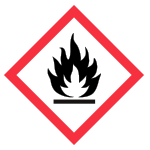
Flame
Flammable gases, aerosols, liquids and solids; pyrophoric and self-heating products; products that give off flammable gas in contact with water; self-reactive substances and organic peroxides.
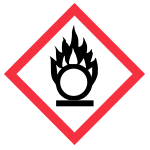
Flame over circle
Oxidizing gases, liquids and solids — they can cause or intensify a fire.
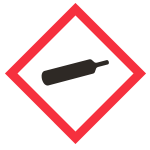
Gas cylinder
Gases under pressure — the container may explode if heated, and some gases are extremely cold.
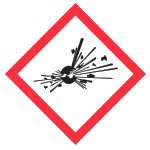
Exploding bomb
Explosives, and some self-reactive substances and organic peroxides.
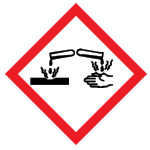
Corrosion
Corrosive to metals; causes severe skin burns; causes serious eye damage.
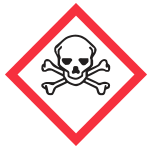
Skull and crossbones
Acute toxicity — can be fatal or toxic after a short exposure, by swallowing, skin contact or breathing it in.
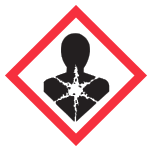
Health hazard
Serious long-term health effects: respiratory sensitizers, germ cell mutagens, carcinogens, reproductive toxicity, specific target organ toxicity, and aspiration hazards.
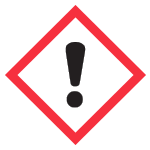
Exclamation mark
Less severe effects: harmful if swallowed, inhaled or in contact with skin; skin and eye irritation; skin sensitization; respiratory irritation or drowsiness.
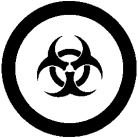
Biohazardous infectious materials
Organisms or their toxins that can cause disease in people or animals. Note the round border.
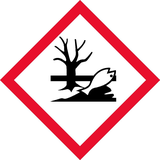
Environment
Hazardous to the aquatic environment. This pictogram is not required under WHMIS, but you may see it on products, especially imported ones.
Some hazard classes or categories have no pictogram — for example, combustible dusts and simple asphyxiants. Their labels still carry a signal word and hazard statements, so always read the whole label, not just the symbols.
Lesson 4 of 6
WHMIS labels
Complete the review questions in the previous lesson to unlock this lesson.
Supplier labels
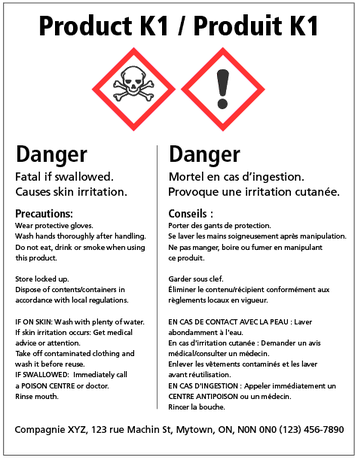
Every hazardous product supplied to a Canadian workplace must carry a supplier label, in both English and French. It includes:
- Product identifier — the product’s name, matching its SDS.
- Initial supplier identifier — the name, address and phone number of the Canadian supplier (or importer).
- Hazard pictograms.
- Signal word — “Danger” for more severe hazards, or “Warning” for less severe ones.
- Hazard statements — what the hazard is, for example “Fatal if swallowed”.
- Precautionary statements — how to prevent harm, respond to an exposure, store and dispose of the product.
- Supplemental information, where needed.
Workplace labels
A workplace label is required when a hazardous product is made in the workplace, when it is transferred (decanted) from its original container into another container, or when the supplier label is lost or can’t be read. A workplace label must show:
- the product identifier;
- safe handling information (this may include pictograms); and
- a statement that a Safety Data Sheet is available.
Workplace labels can be in any format, as long as they show this information clearly. Never use a product from an unlabelled container, and never put a product into a container with someone else’s label.
Lesson 5 of 6
Safety Data Sheets
Complete the review questions in the previous lesson to unlock this lesson.
A Safety Data Sheet (SDS) gives detailed information about a hazardous product: its hazards, how to use and store it safely, and what to do in an emergency. Suppliers must provide one with each hazardous product, and employers must keep SDSs up to date and readily available to workers.
Every WHMIS 2015 SDS uses the same 16 sections, in the same order:
- Identification — product identifier, recommended use and restrictions, supplier details and emergency phone number.
- Hazard identification — hazard classification and the label elements (pictograms, signal word, hazard and precautionary statements).
- Composition / information on ingredients — chemical names, CAS numbers and concentrations.
- First-aid measures — by route of exposure: breathing it in, skin, eyes, swallowing.
- Fire-fighting measures — suitable extinguishing media and special hazards.
- Accidental release measures — personal precautions, protective equipment, containment and clean-up.
- Handling and storage — safe handling, and conditions for safe storage, including incompatible materials.
- Exposure controls / personal protection — exposure limits, engineering controls and personal protective equipment (PPE).
- Physical and chemical properties — appearance, odour, flash point, boiling point, vapour pressure and more.
- Stability and reactivity — conditions and materials to avoid, and hazardous decomposition products.
- Toxicological information — routes of exposure, symptoms, and short- and long-term health effects.
- Ecological information.
- Disposal considerations.
- Transport information — UN number, shipping name and transport hazard class.
- Regulatory information.
- Other information — including the date of the latest revision.
Know where the SDSs are kept at your workplace, and read the SDS before you work with a product for the first time. In an emergency, sections 2, 4, 5, 6 and 8 are the ones you will need first.
Lesson 6 of 6
Emergencies and safe work
Complete the review questions in the previous lesson to unlock this lesson.
If there is a spill or an exposure
- Follow your workplace’s emergency procedures. Get yourself and others away from danger and raise the alarm.
- Check the label and SDS section 4 for first aid. For many products this means flushing skin or eyes with clean water for at least 15 minutes, or moving to fresh air.
- Get medical help when needed, and bring the SDS or label with you.
- Clean up spills only if you are trained to do so and have the right PPE — see SDS sections 6 and 8.
- Report every spill, exposure and near miss to your supervisor.
Everyday safe work practices
- Read the label and SDS before using a product, and follow the precautions.
- Use the ventilation, controls and PPE the SDS calls for, and make sure your PPE fits and is in good condition.
- Store products as the SDS directs, and keep incompatible products apart (SDS sections 7 and 10).
- Keep containers closed and labelled, and never eat, drink or smoke where hazardous products are used.
- Wash your hands after handling hazardous products.
Heat and cold stress
Working in hot environments can be uncomfortable and can also harm your health: drink water often, take breaks in a cool place, and watch for signs of heat illness such as dizziness, headache and heavy sweating. Working in cold weather can be dangerous if you are unprepared: wear proper insulated clothing in layers, keep dry, and watch for numbness and shivering in yourself and your co-workers.
Final test
Final test
Complete all 6 lessons to unlock the final test.
Answer all 15 questions. You need 12 correct answers to pass. You can retake the test as many times as you like.
Order your WHMIS certificate (optional) — $20
Your certificate shows your name, the course and the date you passed. Enter your name exactly as it should appear on the certificate.